
“Loop engineering” is one of the latest buzzwords making the rounds in artificial intelligence circles.
Maybe it’s catching on because it’s genuinely useful.
Maybe it’s catching on because loops consume a lot of tokens and frontier AI companies are happy to sell more compute.
Either way, if you’ve heard the term and wondered what it actually means, you’re not alone.
The good news is that the concept is much simpler than the name suggests.
What Is Loop Engineering?
At its core, a loop is just a repeating cycle:
- Perform a task
- Evaluate the result
- Decide what to do next
- Repeat until a goal is achieved
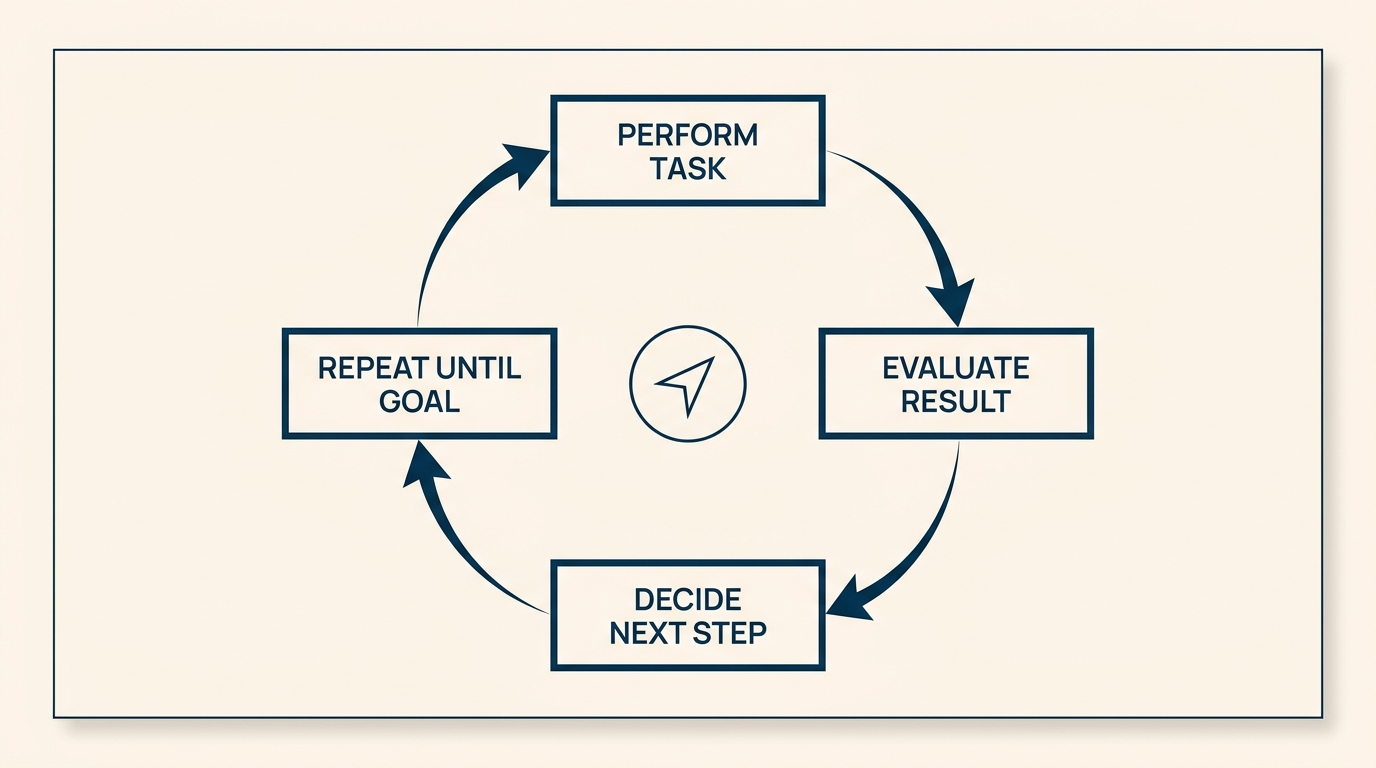
Software engineers have been building loops forever. Retry mechanisms, monitoring systems, feedback loops, scheduled jobs, and automation workflows all rely on similar concepts.
What’s different today is that large language models are surprisingly good at making decisions when things don’t go according to plan.
Instead of following a rigid set of instructions, an AI-powered loop can often determine the next step on its own.
A Real-World Example
Recently, I had a project that required collecting data from a platform every single day.
Most of the data was available through an API, but there was one specific piece of information that wasn’t directly accessible.
Traditionally, I would have written a script to gather the data, scheduled it to run every morning, and configured alerts to notify me when something broke.
That approach works.
The problem is that it’s often brittle.
Authentication tokens expire.
Websites change.
Unexpected errors occur.
And eventually I find myself spending time troubleshooting a process that was supposed to be automated.
Instead, I approached the problem differently.
I created a loop around an AI agent.
Every day, the agent attempts the task.
It checks whether the desired data was successfully collected.
If something fails, it documents the issue, attempts to diagnose the problem, and tries potential solutions.
If it fixes the issue, great.
If it cannot resolve the problem after a defined number of attempts, it escalates the issue to me.
The key difference is that I am no longer prescribing every possible step the system should take.
Instead, I’m defining the outcome I want and establishing the guardrails within which the agent can operate.
Why This Is Different Than Traditional Automation
Traditional automation is process-oriented.
You define the path.
Click this button.
Call this API.
Parse this response.
Store this value.
If any part of that path changes unexpectedly, the automation often fails.
Loop-based systems are more outcome-oriented.
You define success.
The system is then allowed to explore different paths to achieve that success while staying within established constraints.
This is why people often describe AI agents as feeling more like employees than scripts.
A script executes instructions.
An agent pursues objectives.
That’s an oversimplification, but it’s useful for understanding why these systems feel different.
The Importance of Recurrence
One aspect of loop engineering that often gets overlooked is that many loops aren’t designed to run once.
They’re designed to run continuously.
Every day.
Every hour.
Every week.
The agent isn’t simply completing a task and disappearing.
It is repeatedly working toward an objective over time.
When conditions change, the loop adapts.
When errors occur, the loop attempts recovery.
When a process can be improved, the loop can document and implement those improvements.
This ongoing ownership is where things start becoming interesting.
The goal isn’t simply automation.
The goal is reducing the amount of human attention required to maintain the automation.
Guardrails Matter
Of course, none of this works without constraints.
An unconstrained loop can become expensive, ineffective, or even dangerous.
A poorly designed agent might repeatedly make the same mistake forever.
It might consume enormous amounts of compute trying increasingly creative solutions.
Or it might confidently declare success when it actually failed.
That’s why verification and stopping conditions matter.
In my example, a separate verification process confirms that the task was actually completed.
The agent is only allowed a limited number of recovery attempts.
Certain actions still require human involvement.
For example, if two-factor authentication is required, I step in rather than granting the agent unrestricted access.
The goal is not autonomy at all costs.
The goal is useful autonomy within reasonable boundaries.
Is Loop Engineering Actually New?
That’s the question I keep coming back to.
If we’re being honest, many of the underlying ideas have existed for decades.
Monitoring systems.
Retry logic.
Automation workflows.
Feedback mechanisms.
Human escalation paths.
None of those concepts are new.
What is new is the addition of AI reasoning to those systems.
Instead of coding every possible response to every possible failure, we can increasingly allow models to reason through problems and attempt solutions on our behalf. This is why infrastructure matters more than the tools themselves. You need the right systems in place for AI to actually be useful.
Whether that deserves an entirely new discipline called “loop engineering” remains to be seen.
But the underlying concept is real.
And for many practical business workflows, it’s one of the more useful developments emerging from the agentic AI movement.
Final Thoughts
The simplest way I can explain loop engineering is this:
Traditional automation focuses on the process.
Loop-based systems focus on the outcome.
You tell the system what success looks like.
The loop keeps working toward that objective, adapting when conditions change and escalating only when it reaches its limits.
That’s not magic.
It’s not artificial general intelligence.
But it is a meaningful step toward systems that can take responsibility for recurring work rather than simply executing instructions.
And that’s why so many people are paying attention.
Keep Reading
What Are AI Agents? (And Why They're More Than Just Chatbots)
AI agents are everywhere right now. Here's what they actually are, how they differ from basic LLMs, and why the real opportunity is in the infrastructure around them.
How to Manage FOMO in the AI Era
Every day brings news of a new AI model, benchmark, or framework. The pressure to keep up is relentless, and largely unnecessary. Here's how to filter the noise and focus on what actually matters.
How I'm Using AI for Marketing Intelligence and as a Builder (Spring 2026)
A technical deep-dive into my AI setup: CLI tools, virtual machines, custom agents, and why building your own system matters more than copying someone else's.